StepGoals is an iPhone step tracking app with a built-in walking journal that lets you log your mood, write a note, and attach photos — all tied to your step count for the day. It's one of the more personal features in the app, and the one I'm most happy exists when I scroll back through old entries. Whether a unique photo moment caught my eye on a stroll or I wanted to record how I was able to achieve a new personal best, the journal is there for me.
The limitation of step counts alone
Step counts are useful. They're measurable, and over time they reveal patterns. But a number by itself doesn't carry much meaning. 8,847 steps on a Tuesday in November tells you very little about what that day was actually like.
Was it a good day? A hard one? Did you go somewhere new? Were you stressed and needed to move, or were you energized and just couldn't stop? A step count captures none of that. Months later, looking back at a chart, every high-step day looks the same.
That's the gap the journal fills. It adds a layer of context that turns a number into a memory.
| Step count alone | Step count + journal entry |
|---|---|
| 8,847 steps on Tuesday | 8,847 steps — post-meeting walk, felt good, photo of the park |
| No context for high-step days | Mood notes reveal what actually drove performance |
| Numbers that look the same in a chart | Days with distinct stories and conditions |
| Can't explain dips or spikes | Own notes surface patterns months later |
How the StepGoals walking journal app works
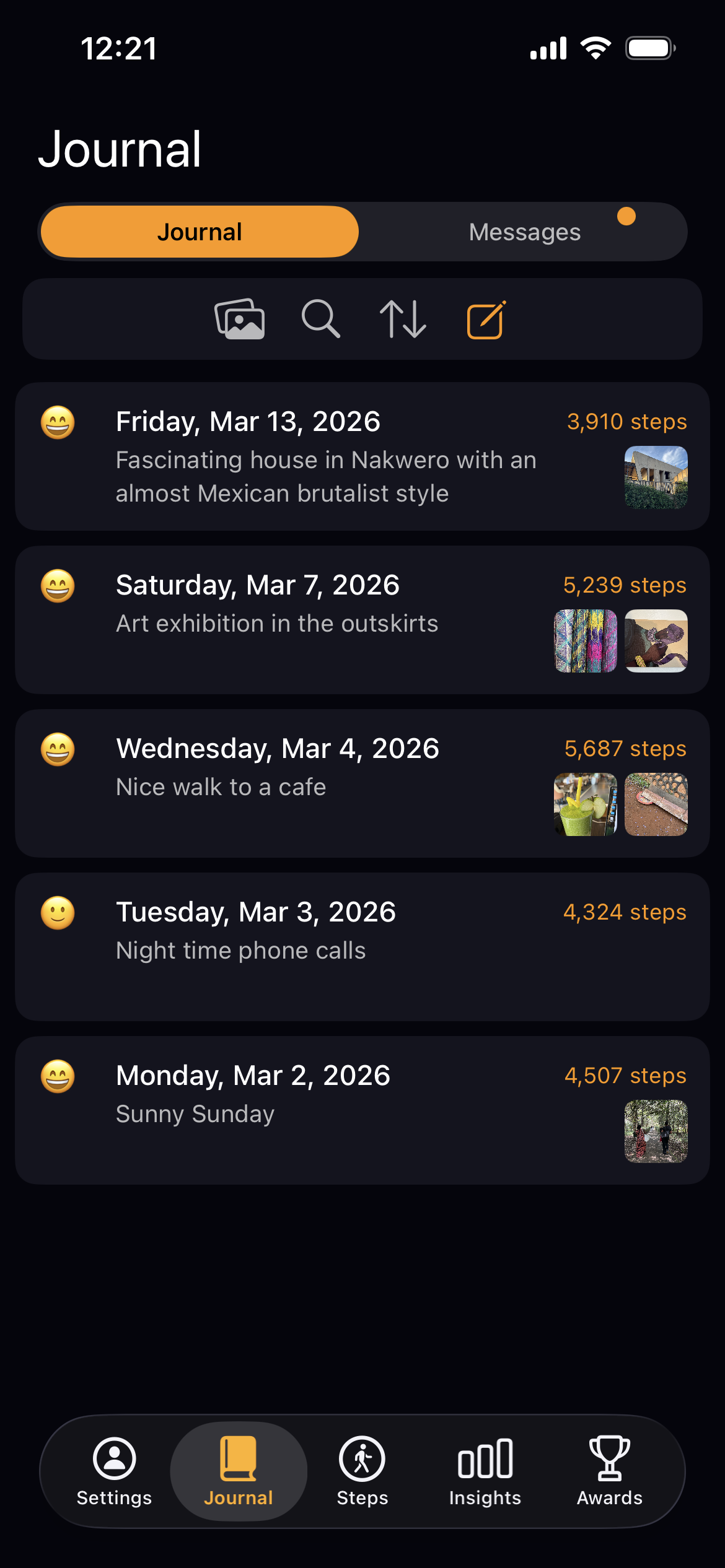
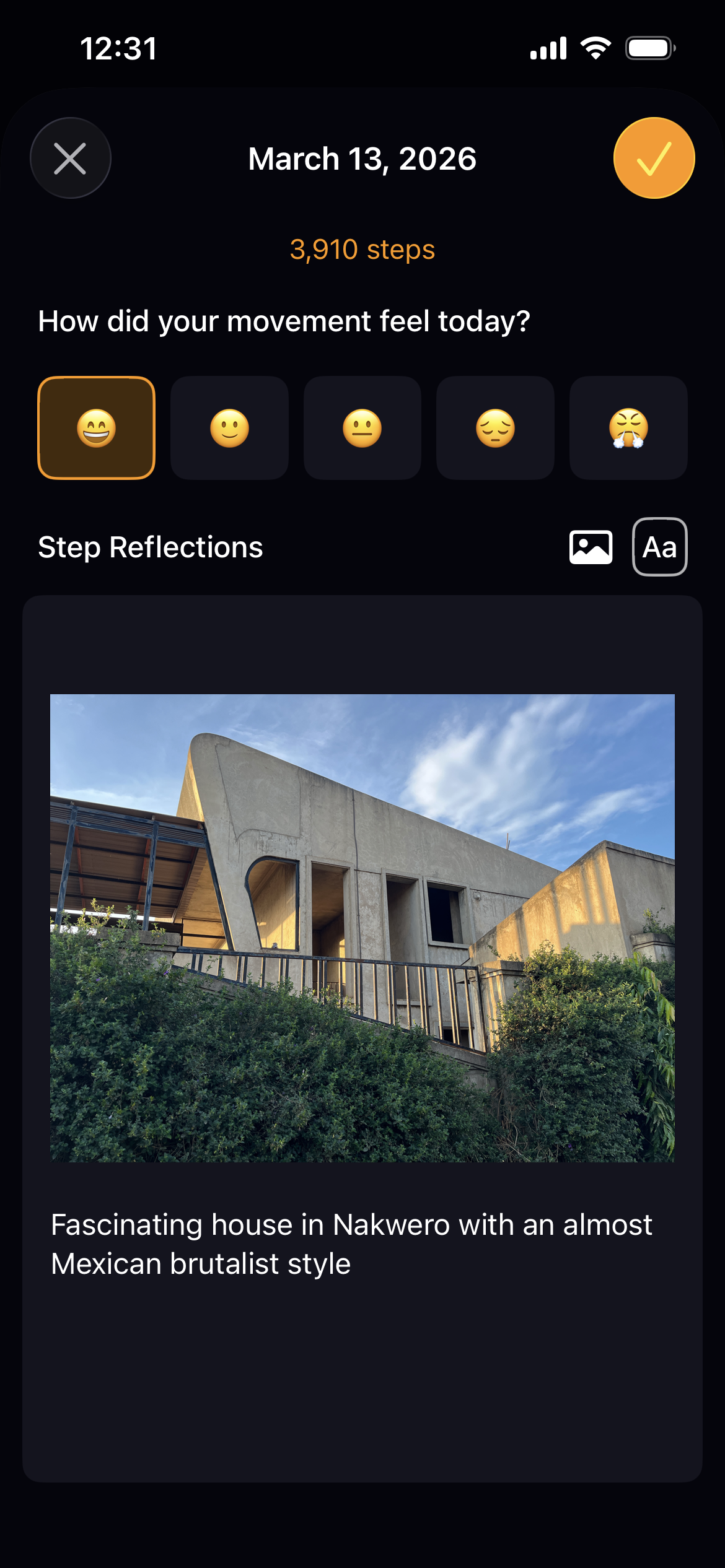
The journal lives in the second tab of the app. Creating an entry takes about thirty seconds. You pick a mood (which is optional) — represented by an emoji that covers the usual range from exhausted to great — write whatever's on your mind, and optionally attach one or more photos. Your step count for the day is pulled in automatically for your reference.
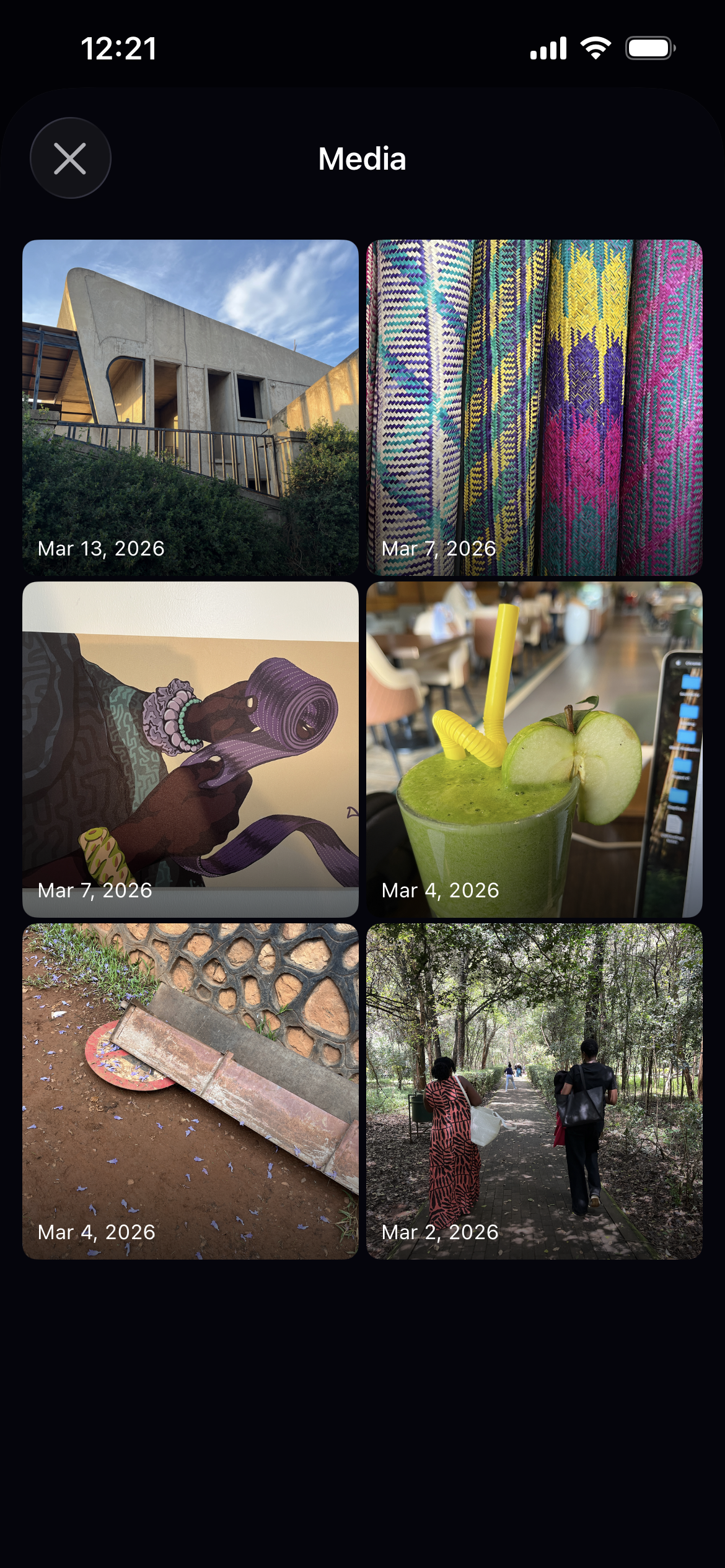
Entries are stored locally on your device for your privacy. You can edit or delete any entry at any time, and browse your full history in reverse chronological order. Tapping an entry shows the full text, your mood, your photos, and the step count from that day. From the list of journal entries, tapping on the photos icon opens your media library of pictures from your journals.
Why mood matters more than you'd expect
I added mood tracking to the journal because I wanted to remember the conditions that led to my best performance. Does a good mood lead to more steps, or do more steps lead to a good mood? Almost certainly both — a 2013 review by Mammen and Faulkner in the American Journal of Preventive Medicine found that regular physical activity significantly reduces risk of depression and improves mood outcomes, while on the other side, positive affect independently predicts greater physical activity levels. The journal is there to capture both sides of that relationship in your own life.
After using it for a few weeks, some patterns became obvious. My lowest-step days clustered around a specific kind of tired — not physical tiredness, but the drained, over-scheduled kind. My best days weren't always the ones where I planned a long walk. They were often ordinary days where I just kept moving, one errand, detour or dance party at a time.
Seeing that in your own data, tied to your own notes, is different from reading a study about general trends. It's personal evidence. And personal evidence is what actually changes behavior and cultivates motivation.
Photos: the underrated part
Photos are optional, but as a photographer I don't leave them out. Walking the same routes becomes invisible after a while — your brain stops registering what you're seeing. Having a reason to occasionally stop and take a photo forces you to actually look.
The photos in the journal don't need to be shared, but they certainly can be if something special caught your eye. Flower petals on the ground during a rainy morning walk, a dog you pass every Tuesday, the view from a hill you finally climbed. StepGoals is a walking app that also turns into a quiet archive of the places and side quests your steps took you.
Journaling and habit formation
There's good reason that habit research consistently points to self-reflection as one of the strongest predictors of behavior change. A 2016 meta-analysis by Harkin et al. in Psychological Bulletin, covering 138 studies, found that self-monitoring of progress — particularly when it includes recording — significantly improves goal achievement rates. Writing things down, even briefly, creates a feedback loop that pure data tracking doesn't. It closes the day with a small act of reflection, which makes the next day slightly more intentional.
A step tracking journal doesn't need to be elaborate to be useful. A mood, two sentences, and a photo on a good day is enough. Over time, the entries accumulate into something that a step count chart never could: a record of what it actually felt like to build the habit.
Try the walking journal in StepGoals for iPhone
The journal is free and available to all StepGoals users. Open the app, tap the journal tab, and write your first entry after today's walk. Future you will be glad you did.
StepGoals is one of the best motivational step tracking apps for iPhone — see how it compares to the competition.
Download StepGoals free and start your walking journal today.
